
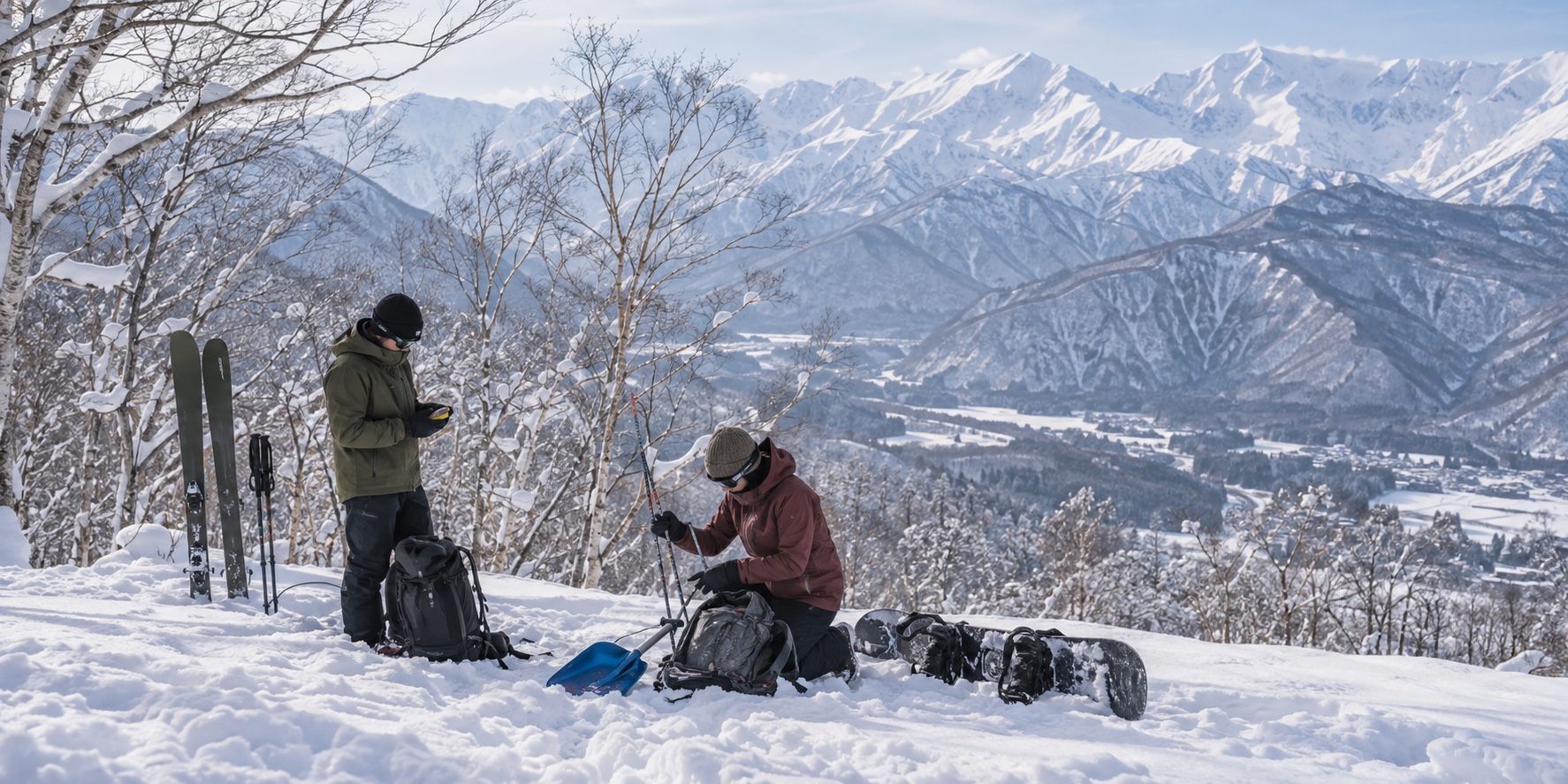
If you enter uncontrolled avalanche terrain in Japan, each person in your group should carry an avalanche transceiver, probe, and shovel. These three tools support companion rescue: the rescue carried out by the people already on the scene.
The equipment does not prevent an avalanche. It also does not replace training, careful terrain choices, current avalanche information, or local rules.
POINT
- Transceiver: sends a signal and helps partners search for a buried person.
- Probe: physically pinpoints the person's position after the transceiver search.
- Shovel: removes the dense avalanche debris above and around the person.
- Training: makes it possible to use all three tools quickly and in the correct order.
Warning
Rescue equipment is a last line of defence after someone has been buried. Avoiding burial remains the priority.
The Core Three Avalanche Tools: Transceiver, Probe, and Shovel
The Japan Avalanche Network identifies the transceiver, probe, and shovel as the basic avalanche rescue set. It also says each group member needs their own equipment and regular practice.
Avalanche Transceiver (Beacon)
An avalanche transceiver, often called a beacon, can transmit and search for a radio signal. During travel, each person's unit stays in transmit mode. If someone is buried, the other group members switch their units to search mode and follow the signal.
Wear the transceiver securely on your body as its manufacturer directs, rather than loose in a backpack. Before leaving, check its self-test and battery display, confirm that everyone is transmitting, and complete a group function check. Follow the manual for battery replacement and for separation from phones, magnets, and other electronics.
Probe
A probe is a long, collapsible pole. After the transceiver search brings rescuers close, systematic probing confirms the person's exact position and burial depth. This tells the group where to dig.
A probe is not a substitute for a transceiver. The two tools perform different stages of the same rescue.
Shovel
The shovel removes avalanche debris after the probe has marked the burial point. Avalanche debris can be hard and dense, so use a purpose-built metal avalanche shovel rather than a small plastic camp shovel.
Carry the probe and shovel where you can reach them quickly. Do not pack them underneath items that would slow the rescue.
Practice matters as much as ownership
Owning the three tools is not the same as being able to rescue a partner. Companion rescue combines a transceiver search, probing, shovelling, first aid, and decisions about scene safety. It is stressful and physically demanding.
Take practical avalanche training and repeat realistic rescue practice. At the start of each day, confirm that every person has a working transceiver, probe, and shovel. Check that the transceivers are in transmit mode before entering avalanche terrain.
Avalanche Canada's equipment guidance also explains the three tools, start-of-day checks, battery checks, airbags, and emergency communication.
Airbags and helmets are supporting equipment
Avalanche airbag
A deployed avalanche airbag may help a person stay nearer the surface or reduce burial depth. It cannot guarantee that the person will avoid burial, trauma, or death. Deployment can also fail, and terrain features can allow snow to pile over a person.
An airbag does not replace a transceiver, probe, shovel, training, or careful decisions.
Helmet
A helmet is not part of the core transceiver, probe, and shovel companion-rescue set, but it remains important protective equipment for skiing and snowboarding. It may reduce some head injuries from impacts. The current Niseko Rules say people entering backcountry areas should wear one.
A charged phone, an offline map or GPS tool, and a satellite communicator can support navigation or a call for outside help. Choose tools that suit the route and know how to use them before the trip. Mobile coverage is not reliable in every mountain area.
These devices do not replace companion rescue. A call to an outside rescue service cannot perform the immediate transceiver search, probing, and digging that partners may need to start.
Japan-specific checks before you leave controlled terrain
- Check the current rules for your exact resort, gate, guide company, or tour. They vary from place to place.
- Confirm whether the route is outside ski-patrol control and whether a gate or registration process applies.
- Check the day's avalanche bulletin and weather forecast. Having the right gear tells you nothing about snow stability. See our guide to Checking Avalanche Conditions in Japan.
- Make sure every person's rescue gear is functional and immediately accessible.
For example, Hakuba Valley's official safety guidance identifies the transceiver, probe, and shovel as an avalanche safety kit and says pre-season training is important. It also gives area-specific gate and registration guidance.
The Niseko Rules say everyone in backcountry areas should wear a helmet and carry an avalanche beacon, and they strongly recommend a probe and shovel as well. These are local rules for the Niseko area, not a rule that applies across Japan.
FAQ
No. Each person should carry a transceiver, probe, and shovel. If one person is buried, the remaining partners need their own complete equipment to carry out the rescue.
Does an avalanche airbag replace the core three?
No. An airbag may reduce burial depth in some avalanches, but it cannot guarantee survival and does not replace a transceiver, probe, or shovel.
Do skiers and snowboarders need different avalanche rescue gear?
No. The core companion-rescue equipment is the same. Other travel equipment may differ, but both skiers and snowboarders use a transceiver, probe, and shovel.
Is avalanche equipment legally required everywhere in Japan?
No single Japan-wide legal requirement for avalanche equipment was found. Requirements may instead be set by a resort, gate, guide company, or tour, so check the current rules for your exact plan. Our guide to off-piste skiing rules in Japan explains how local boundaries and prohibited areas can differ.
Does COCOHELI work like an avalanche beacon?
No. An avalanche transceiver supports immediate companion rescue after burial. COCOHELI supports an organized search using its own transmitter and compatible receivers. The two systems are not interchangeable.
Final takeaway
For uncontrolled avalanche terrain in Japan, start with one functional transceiver, probe, and shovel per person. Carry them correctly, practise with them, and check them at the start of every day.
Add communication, navigation, an airbag, a helmet, and other winter equipment when they fit your route. More equipment does not turn a poor terrain decision into a safe one.
If you are not confident managing terrain, conditions, and local access independently, read our guide to deciding whether to hire a backcountry guide in Japan.