
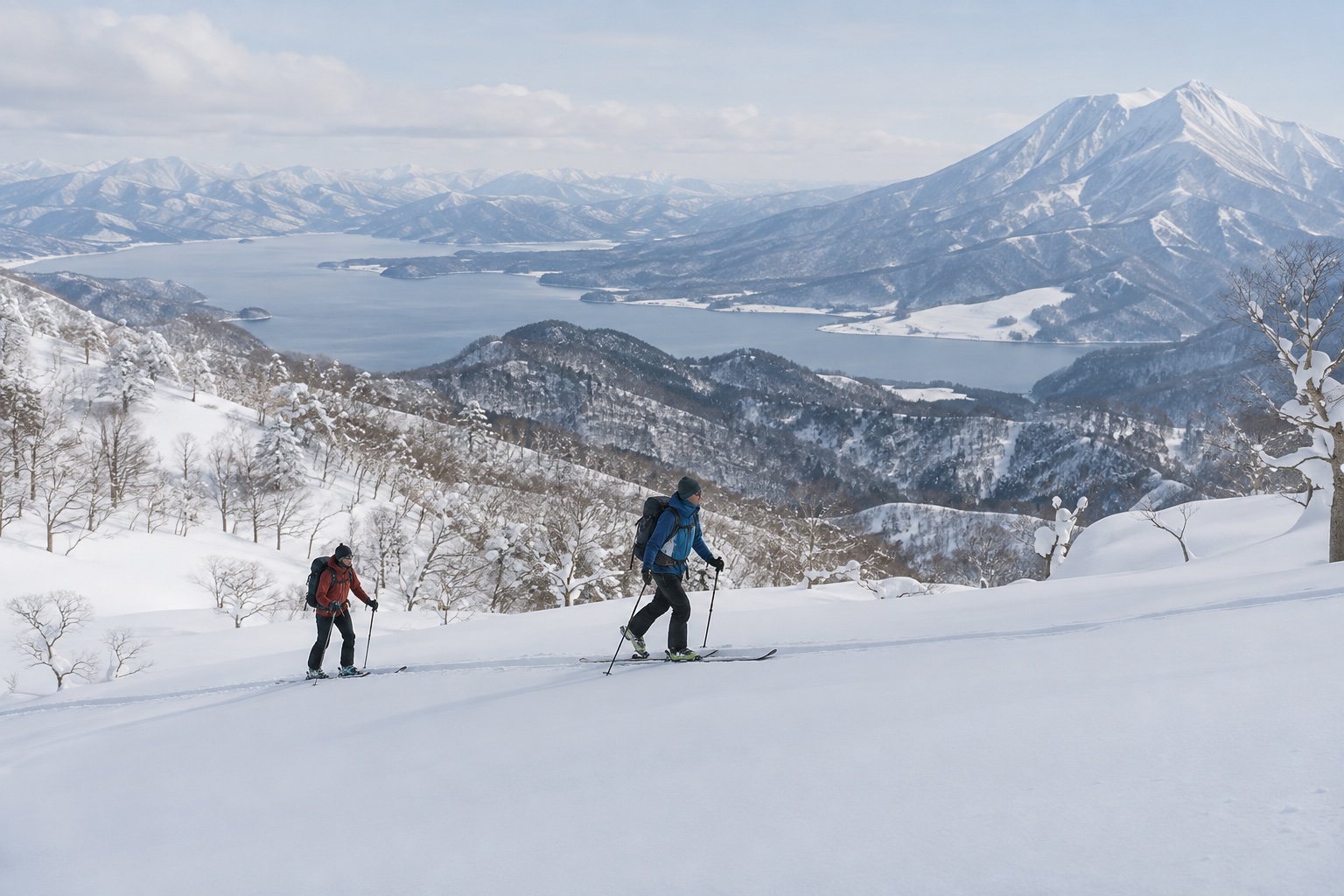
Japan offers amazing backcountry skiing and snowboarding, but that does not mean every visitor should go without local help. For many foreign visitors, hiring a backcountry guide in Japan is the safer and more realistic choice, especially if you do not know the terrain, cannot read local information easily, or are not fully confident making avalanche and route decisions in unfamiliar mountains.
POINT
- A guide is often a smart choice if this is your first backcountry trip in Japan.
- A guide becomes more valuable when avalanche conditions, visibility, route-finding, or language barriers add uncertainty.
- Going without a guide may be reasonable for riders who already have strong backcountry decision-making skills, suitable equipment, local planning information, and a conservative approach.
- Even skilled visitors still need to check local rules, avalanche information, weather, and rescue limitations before going out.
The short answer
You do not automatically need a guide just because you are a foreign visitor. But many visitors should seriously consider one. Japan's backcountry can look friendly on a powder day, yet the real difficulty is often in route choice, terrain traps, tree wells, navigation, weather shifts, gate systems, and rescue consequences if something goes wrong.
A terrain trap is a gully or other feature where avalanche debris can pile up. A tree well is an area of loose, deep snow around a tree trunk.
If you are asking the question because you are unsure, that uncertainty itself is important. In practice, visitors who are new to Japan, new to avalanche terrain, or not confident planning and leading a day in unfamiliar mountains are often better off with a qualified guide.
Warning
A guide reduces some risks, but it does not remove avalanche danger, tree-well danger, injuries, weather problems, or rescue delays. Guided backcountry travel is still backcountry travel.
Why this question matters more in Japan than many visitors expect
Many foreign riders arrive with backcountry experience from North America, Europe, Australia, or New Zealand. That experience helps, but it does not automatically transfer cleanly to Japan. Depending on the area, backcountry travel in Japan may involve unfamiliar boundary and gate systems, dense trees, complex exits, deep-snow hazards, and limited English-language information.
Japan Avalanche Network publishes avalanche bulletins for several mountain areas in Japan. Coverage and update schedules vary by area and season, so check its current bulletin list before each trip.
Nagano Prefecture requires a climbing plan when using one of its designated hiking routes. This is a prefecture-specific rule and should not be treated as a nationwide backcountry requirement.
This does not mean every visitor needs a paid guide every time. It means you should make the decision based on your real ability to manage Japan-specific uncertainty, not on confidence alone.
When using a backcountry guide in Japan makes the most sense
A guide often makes sense when one or more of these apply:
- It is your first backcountry trip in Japan.
- You have avalanche gear but limited training using it in real terrain.
- You are strong in-bounds riders but newer to independent touring or splitboarding. Touring means traveling uphill on skis fitted with climbing skins. A splitboard separates into two ski-like sections for the climb.
- You cannot confidently assess avalanche terrain, terrain traps, and route options.
- You do not know the local access system, gates, exit routes, or common mistakes in that area.
- You cannot easily read local information in Japanese and are not sure what you may be missing.
- Your group has mixed ability, mixed fitness, or mixed risk tolerance.
- You want to enter a new area where navigation mistakes could create a long, serious exit.
- Weather, visibility, or snowpack conditions are adding uncertainty.
For many visitors, a guide is most useful not because they cannot ski powder, but because they cannot yet make the full set of mountain decisions safely in an unfamiliar environment.
- Local terrain knowledge
- Safer route selection for the day's conditions
- Better group management
- Clear turnaround decisions
- Faster recognition of hazards visitors often underestimate
- Help interpreting local systems, access points, and practical logistics
That said, do not assume every person advertising tours offers the same level of training, scope, or terrain judgment. The Japan Mountain Guides Association (JMGA) publishes Ski Guide Stage I and Stage II qualifications with defined operating scopes. Under the JMGA system, terrain that normally requires rope use falls under its mountain-guide qualification rather than its ski-guide scope. This describes the JMGA credential system; it does not make JMGA Japan's only legal guide qualification.
Before booking, check that the guide's current qualification matches the planned terrain. JMGA's active-guide directory shows members' qualifications, affiliations, and expiry dates.
Also ask the operator about its emergency plan and liability insurance, and what insurance you must arrange yourself. Do not assume that the operator's insurance covers your medical treatment, rescue, or evacuation costs.
When going without a guide may be reasonable
Some visitors do go independently, and that can be a reasonable choice in limited cases. Usually that means the group already has strong backcountry decision-making skills, avalanche training, route-planning ability, navigation tools, emergency communication planning, and a conservative approach to terrain.
Going without a guide may be more realistic when these conditions are met:
- You have real backcountry experience beyond resort sidecountry laps—terrain reached from a resort but outside its controlled area.
- You and your partners know how to plan a tour, not just follow a track.
- You can use beacon, shovel, and probe efficiently.
- You can recognize when not to go.
- You understand that legal access and safe access are not the same thing.
- You have checked the local avalanche outlook, weather, wind, and route-specific consequences.
- You have a realistic exit and emergency plan.
A beacon, also called an avalanche transceiver, helps partners locate a buried person. A probe pinpoints the location, and a shovel is used to dig.
Even then, staying conservative is wise. Independent travel in Japan is not a test of pride. If conditions are marginal or your group is unsure, that is often the moment when a guide becomes the better option.
Questions to ask yourself before deciding
- Have I made backcountry decisions myself in avalanche terrain before?
- Would I be comfortable planning the whole day if there were no existing track to follow?
- Do I understand the local access rules and boundary system where I want to go?
- Can my group manage a bad-weather navigation problem or complicated exit?
- Do we all carry and know how to use appropriate avalanche equipment?
- Do we know what rescue and medical support may look like in this area?
- Would hiring a guide reduce uncertainty, not just increase convenience?
If several of those questions make you hesitate, a guide is probably a smart choice.
What a guide does not replace
Hiring a guide should not become a shortcut for basic preparation. You still need to think about:
- Whether your insurance actually covers the activity you plan to do
- Whether you understand resort and gate rules
- Whether your gear matches the day and terrain
- Whether your fitness level matches the objective
- Whether your group communicates honestly about risk and ability
A guide also does not guarantee that a rescue will be simple, fast, or free. If something goes wrong in the backcountry, the consequences can still be serious.
FAQ
Is a backcountry guide legally required in Japan?
This review did not identify a single nationwide rule requiring every backcountry skier or snowboarder in Japan to hire a guide. That is not the same as permission to travel independently everywhere. Access rules, permits, protected-area restrictions, resort policies, and tour conditions can vary by destination and season. Check the current official rules for the exact place you plan to visit, and ask the relevant resort, local authority, or tour operator if the requirements are unclear.
Should beginners to the backcountry hire a guide in Japan?
Hiring a guide is a sensible default if you are new to avalanche terrain or independent touring. Hakuba Valley's official safety guidance, for example, recommends that inexperienced riders be accompanied by a guide. That guidance is specific to Hakuba Valley. Wherever you ride, do not lead an independent backcountry day unless you can manage the terrain, conditions, navigation, equipment, and emergency plan yourself.
What if I am experienced in another country?
Your experience still matters. But you should be honest about what transfers well and what does not. Familiarity with avalanche terrain helps. Familiarity with Japan-specific access systems, tree density, exits, local information, and rescue realities may still be limited.
Does guided backcountry travel mean no avalanche gear is needed?
No. A guide does not automatically replace personal safety equipment. Equipment rules and operator requirements vary by area and trip. Hakuba Valley's official guidance lists a beacon, probe, and shovel for backcountry travel whether guided or not. Niseko's official rules use different wording and strongly recommend carrying a beacon, probe, and shovel. Follow the current local rules and the operator's trip-specific equipment list, and confirm what is provided or available to rent.
How do I decide in one sentence?
If you can ski or ride well but cannot confidently manage the whole mountain decision-making process in Japan on your own, a backcountry guide is usually the better choice.
Final takeaway
Many foreign visitors do not need a guide because they are foreign. They need a guide because Japan's backcountry asks for local judgment, route discipline, and honest risk management. If you have strong independent skills and have done the work, going without a guide may be reasonable. If you are uncertain, unfamiliar, or still building those skills, using a guide is often the responsible decision.
A simple way to think about it is this: if a guide would mainly add convenience, you may be ready to go independently. If a guide would remove major uncertainty, you probably should hire one.
If you are deciding about Japan backcountry travel, these related guides can help with the next questions most visitors have.
-
-
Is Off-Piste Skiing Legal in Japan? What Most Visitors Get Wrong
Off-piste rules vary by Japanese ski resort. Check current maps, signs, boundaries, and access rules before leaving a marked run.
続きを見る
-
-
Does Your Credit Card Travel Insurance Cover Backcountry Skiing in Japan?
Advertising: This article contains affiliate links. If you buy through them, HakubaSafety may earn a commission at no extra cost to you. Commissions never change our safety advice. See our Affiliate Disclosure. Most riders heading to Japan's mountains assume they're covered. They booked the flights, packed the gear, and somewhere in the back of their mind, they remember that their credit card comes with travel insurance. That feels like enough. It almost certainly isn't — at least not for backcountry or off-piste riding in Japan. This article breaks down exactly where credit card travel insurance falls short in Japan's mountains, ...
続きを見る