.png)
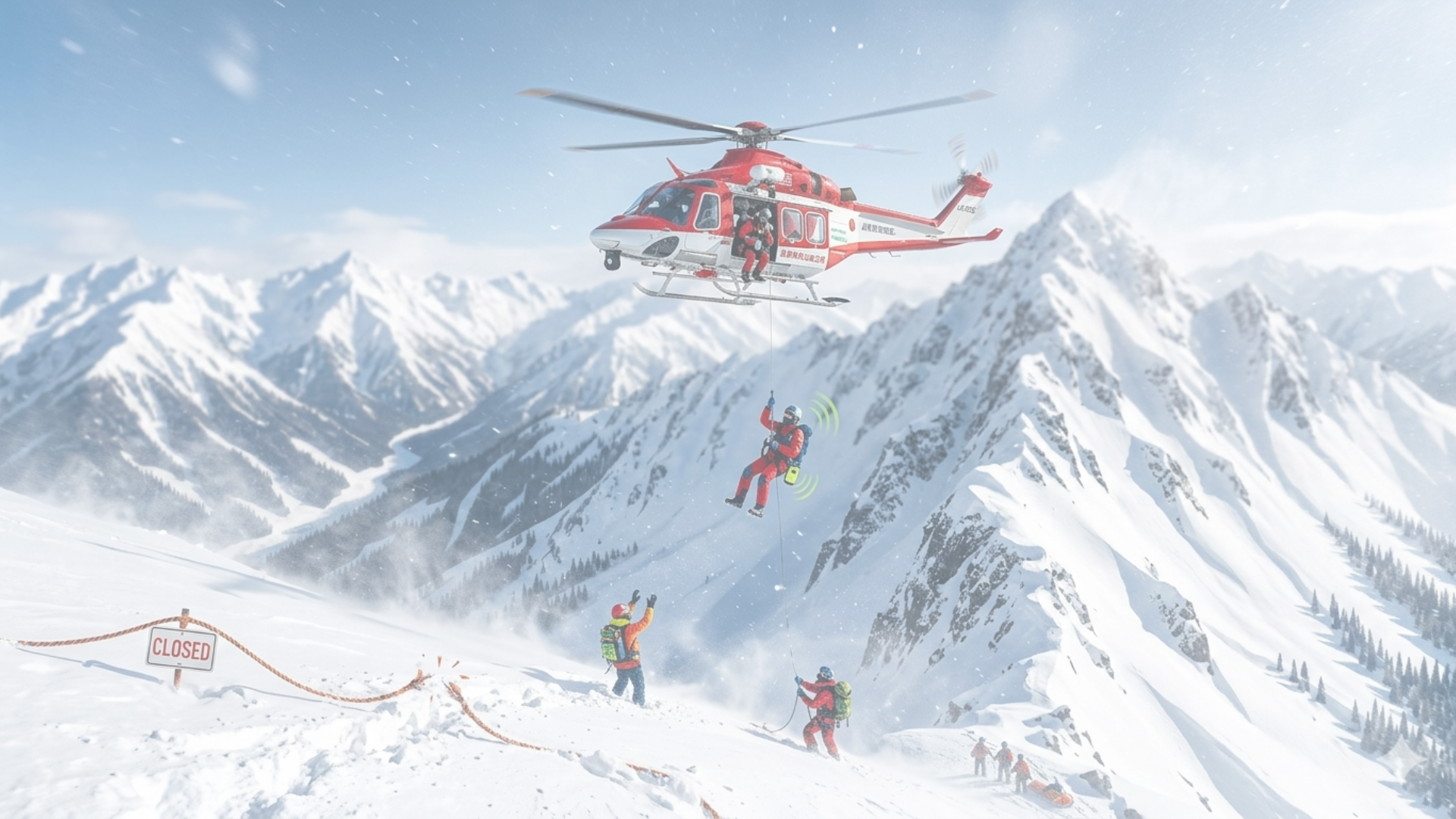
Every winter, thousands of riders flock to Japan, drawn by the irresistible allure of "Japow." The
powder in areas like Hakuba, Niseko, and Myoko is legendary—deep, dry, and seemingly endless. For
many, riding the pristine backcountry or ducking into the sidecountry trees is the ultimate
snowboarding or skiing dream.
But the raw, untamed nature of Japan's winter wilderness holds a harsh reality. When things go wrong
in the Japanese backcountry, they go wrong quickly. A sudden whiteout, an unexpected terrain trap, a
deep tree well, or a triggered avalanche can turn a dream vacation into a desperate fight for survival.
And then comes the aftermath. While surviving a mountain emergency is a blessing, what follows is
often a financial nightmare. A common and dangerous misconception among visiting riders is that if
they get lost or injured, a rescue team will simply pluck them off the mountain for free, or their standard
travel insurance will cover all the bills. This could not be further from the truth.
In Japan, mountain rescue is a complex, highly privatized, and exorbitantly expensive operation. One
wrong turn—especially one that violates local resort rules—can lead to life-altering debt, voiding your
premium travel insurance in an instant. Here is the brutal reality of what a helicopter rescue actually
costs in Japan, why your insurance might abandon you, and the critical piece of technology you need
to prevent financial ruin.
Private Helicopter Rescue in Japan: The Real Cost Breakdown
When you are stranded in the freezing temperatures of the Japanese Alps, your first instinct is to call
for help. You dial 110 (Police) or 119 (Fire and Ambulance). You might assume that because these are
public services, the ensuing rescue will be covered by Japanese taxpayers. This is a fatal
miscalculation.
Why You Can’t Rely on "Free" Police Helicopters
It is true that Japan has prefectural police aviation units and fire department helicopters. If a public
helicopter conducts your search and rescue (SAR), there is generally no charge for the flight itself.
However, relying on a public helicopter is like playing a gamble you cannot afford to lose.
Public helicopters are severely limited. They cannot fly in poor visibility, high winds, or heavy snow—
which are exactly the conditions under which most backcountry accidents occur. Furthermore, they are
restricted from flying at night. If you call for help at 3:30 PM as the sun begins to dip behind the
Hakuba peaks, a public helicopter will not launch. Finally, public helicopters cover entire prefectures
and handle everything from traffic accidents to maritime emergencies. If they are busy, or if the
mountain weather is anything less than perfect, they will not come for you.
The Per-Minute Breakdown of Private Rescue
When the police cannot fly, or when the terrain requires specialized alpine rescue techniques, the
authorities authorize the deployment of private helicopter companies (such as Toho Air Service) and
local Mountain Rescue Prevention Associations (Sangaku Sounan Boshi Taisaku Kyogikai).
These are not volunteers. They are highly skilled, private professionals. And the moment a private
helicopter spins its rotors, the financial meter starts ticking—literally by the minute.
メモ)
The Real Cost of Private SAR in Japan:
・Helicopter Flight Time: Private helicopters charge roughly ¥10,000 to ¥15,000 (approx.
$70 to $100 USD) per minute of flight time. This includes the time it takes to fly from the
base to your location, the search time hovering over the mountain, the extraction, and the
flight to the hospital or drop-off zone.
・Ground Search Teams: A private ground team typically consists of 4 to 8 highly trained
mountaineers. You are billed for their daily rate, which ranges from ¥30,000 to ¥50,000
($200 - $350 USD) per person, per day.
・Equipment and Logistics: You will be billed for snowmobiles, specialized extraction gear,
fuel, and even the administrative coordination fees.
Let’s run a realistic simulation. You are lost out of bounds in Hakuba. It takes a private helicopter 30
minutes to reach the general area, 90 minutes of hovering and searching to locate you in the trees, 30
minutes to execute a hoist extraction, and 30 minutes to transport you to safety. That is 3 hours of
flight time (180 minutes).
At ¥12,000 per minute, the helicopter alone costs ¥2,160,000 (roughly $14,500 USD). Add the cost of
a 6-man ground support team (¥240,000), administrative fees, and immediate ambulance transport,
and your rescue bill easily hits ¥2,500,000 ($16,500 USD).
This is before you have even seen a doctor. A broken femur requiring surgery and a week in a
Japanese hospital at uninsured foreigner rates can add another ¥2,000,000 to ¥3,000,000. You are
now facing a $35,000 USD crisis.
The Insurance Trap: When Your Premium Coverage Becomes Void
Many riders read the numbers above and think, "That’s exactly why I bought premium travel insurance
with winter sports and SAR coverage." It is fantastic that you bought insurance. But in Japan's
mountains, having an insurance policy and having an insurance policy that actually pays out are two
entirely different things.
Before relying on any policy, check whether your exact activity, destination, and Search and Rescue costs are covered.
You can review World Nomads policy options here.
The "Gross Negligence" Clause Explained
This is the trap that catches hundreds of foreign riders every year. Almost every travel insurance policy
in the world contains a standard exclusion clause regarding "Gross Negligence" (sometimes phrased
as "reckless behavior," "willful exposure to needless danger," or "violation of local laws and
regulations").
-
-
Best Travel Insurance for Skiing in Japan: A Practical Comparison for Backcountry & Off-Piste Riders
Why "Standard" Travel Insurance Won't Cut It in Japan Most riders arrive in Japan with some form of travel insurance. Most assume they're covered. Most are wrong. Standard travel insurance policies — the kind bundled with credit cards or booked as an afterthought — typically exclude two things that matter most in Japan's mountains: backcountry and off-piste activities, and Search and Rescue (SAR) costs. In Japan, a private helicopter rescue alone can run ¥1,000,000–¥2,000,000 for a single mission. Hospital treatment for foreign visitors is billed at private rates — typically two to three times the standard cost. And if you ...
続きを見る
Insurance adjusters are not your friends - their job is to investigate the circumstances of your rescue to
see if they are legally obligated to pay. When a claim is filed, the insurance company will request the
official police and ski patrol incident reports. Here is what will trigger an immediate claim denial on gross negligence grounds:
・Ducking a Rope: Ski resort boundaries in Japan are strictly managed. A rope, a bamboo pole
line, or a "Closed" sign is a definitive legal boundary. If the patrol report states you ducked a
rope to access an unpatrolled area, the insurance company considers this a deliberate violation
of safety rules. Claim denied.
・Ignoring the Gate System: In areas like Hakuba, access to the backcountry is managed
through specific "Gates." Exiting the resort anywhere other than an open, official gate is a
violation of local ordinances. Claim denied.
-
-
Japan's Ski Resort Rules: The Vital Difference Between "Off-Piste" and "Prohibited Areas"
Japan’s world-class powder, famously known as "Japow," is a dream for every rider. Many visitors head straight for the trees and sidecountry to find those deep, untouched stashes. However, there is a common and potentially fatal misunderstanding: "In Japan, you can ride anywhere." This is not true. In major areas like Hakuba and Niseko, strict local rules exist to separate managed safety from the raw wilderness. Crossing a single rope without understanding these rules doesn't just put your life at risk—it could also instantly void your insurance. As a former ski resort employee (20 years ago) and a current resident ...
続きを見る
・Lack of Mandatory Equipment: To exit a backcountry gate, local rules dictate you must
possess the minimum avalanche safety gear: a transceiver (beacon), a probe, and a shovel. If
you are rescued and found to be missing this equipment, it is deemed reckless behavior. Claim
denied.
The moment you make the choice to duck a rope for that one untracked line, you are effectively setting
your insurance policy on fire. You are completely on your own.
Paying Upfront: Hospitals and Helis Don’t Wait
What happens if your insurance is voided due to gross negligence, or if your provider insists on a "pay
and claim later" reimbursement model? You will need to pay out of pocket.
Japanese private helicopter companies and hospitals do not operate on credit, especially for foreign
tourists who might leave the country and never return. You will be expected to settle the rescue and
medical bills before you are discharged. Maxing out multiple credit cards is the standard outcome.
Furthermore, the Japanese government takes unpaid medical and rescue debt extremely seriously.
The Ministry of Health, Labour and Welfare shares data with the Immigration Services Agency.
Leaving Japan with an unpaid debt of even ¥10,000 can result in you being flagged at the border. The
next time you try to visit Japan, you could be denied entry and deported. A ruined financial state and a
permanent ban from Japan is a heavy price to pay for a single powder run.
The Missing Link: Why "Time" is Your Biggest Enemy
If we look closely at the mechanics of a rescue, the most expensive factor is not the helicopter itself—it
is Search Time.
The Japanese backcountry is vast, heavily wooded, and characterized by incredibly deep snowpacks.
When a rider goes missing, they are often obscured by thick trees, buried in a tree well, or hidden at
the bottom of a deep ravine. From the air, finding a human wearing a black or grey snow jacket in the
Japanese wilderness is like finding a needle in a haystack.
If you only have a standard avalanche beacon, you are at a massive disadvantage when it comes to a
helicopter rescue. Avalanche beacons transmit on the 457 kHz frequency. They are designed for
companion rescue—meaning your friends who are standing 30 to 50 meters away from you. A
helicopter flying hundreds of feet above the canopy, moving at high speeds, cannot efficiently track a
457 kHz signal over a wide area.
As a result, the helicopter must fly complex grid patterns, relying largely on visual spotting. Hours turn
into days. The ¥12,000-per-minute meter runs relentlessly. If bad weather rolls in, the search is
suspended, and you are left to survive the night in sub-zero temperatures. To survive the physical
ordeal and avoid the catastrophic financial toll, you must eliminate the search time. You need the
rescue team to know exactly where you are the moment they launch.
The Game Changer: Introducing COCOHELI
For years, the problem of massive search times and exorbitant rescue costs plagued Japanese
authorities and riders alike. The solution emerged in the form of a revolutionary service that has now
become the gold standard for mountain safety in Japan: COCOHELI (ココヘリ).
If you are planning to set one foot outside a marked piste in Japan, understanding and carrying
COCOHELI is just as important as carrying your snowboard.
What is COCOHELI?
COCOHELI is a membership-based search and rescue service operated by a Japanese company
called AUTHENTIC JAPAN. It relies on a proprietary Radio Frequency (RF) transmitter. When you sign
up (or rent a device), you are given a small, lightweight transmitter tag. This tag emits a unique ID
signal on a specific radio frequency.
Unlike a standard avalanche beacon, the COCOHELI signal is incredibly powerful. A receiver mounted
on a rescue helicopter can pick up your COCOHELI signal from up to 16 kilometers (10 miles) away.
The receiver provides the helicopter crew with directional data and proximity alerts, guiding them
directly to your exact location with pinpoint accuracy.
How It Saves Time, Money, and Lives
The impact of COCOHELI on mountain rescue in Japan has been staggering. By eliminating the
"search" phase of Search and Rescue, COCOHELI reduces missions that used to take days into
operations that take mere minutes.
When you are reported missing, the SAR team inputs your unique COCOHELI ID into their system. As
soon as the helicopter takes off, they are not randomly searching grids; they are flying directly along
your radio beam. This drastically increases your chances of survival if you are injured or hypothermic.
But COCOHELI is not just a tracking device; it is a financial shield. A COCOHELI membership
includes coverage for the cost of the search itself. Under their standard plans, COCOHELI covers up
to ¥5.5 million (approx. $36,000 USD) in personal search expenses, including the deployment of
private helicopters and ground teams. By carrying this device, you ensure that even if you face a
complex rescue, the catastrophic hourly costs of the helicopter search are mitigated.
It Does NOT Replace Your Avalanche Beacon
It is vital to understand the difference between your safety tools. COCOHELI is for Professional
Rescue. Your Avalanche Beacon (Transceiver) is for Companion Rescue.
If you are buried in an avalanche, you have approximately 15 minutes before asphyxiation becomes
highly likely. A helicopter will never arrive in 15 minutes. In an avalanche scenario, your only hope is
the friends riding with you, using their 457 kHz beacons to find you, and their probes and shovels to
dig you out.
COCOHELI is for the scenarios where immediate companion rescue is not enough. If you fall into a
ravine and break your leg, if you get lost in a whiteout and cannot hike out, or if your group is
incapacitated. COCOHELI guides rescue teams directly to your exact location.
Prepare for the Worst, Ride the Best
Japan’s backcountry is unforgiving. The rules exist not to ruin your fun, but to keep you alive and
out of crippling debt. If you want to experience the best of Japow without the looming threat of a
$20,000 rescue bill, the formula is simple:
1.Follow the Rules: Never duck ropes. Use official gates. This ensures your travel
insurance remains valid and isn't voided by "gross negligence."
2.Carry the Gear: Always ride with a beacon, probe, and shovel, and know how to use
them to save your friends.
3.Carry COCOHELI: Equip yourself with the RF transmitter so that if the worst happens, the
rescue helicopter can find you in minutes, and the search costs are covered.
Are you a foreign visitor wondering how to get your hands on this critical gear?
In our next article, we will provide a complete, step-by-step guide on how foreign
tourists can rent and register a COCOHELI device for their Hakuba trip.