
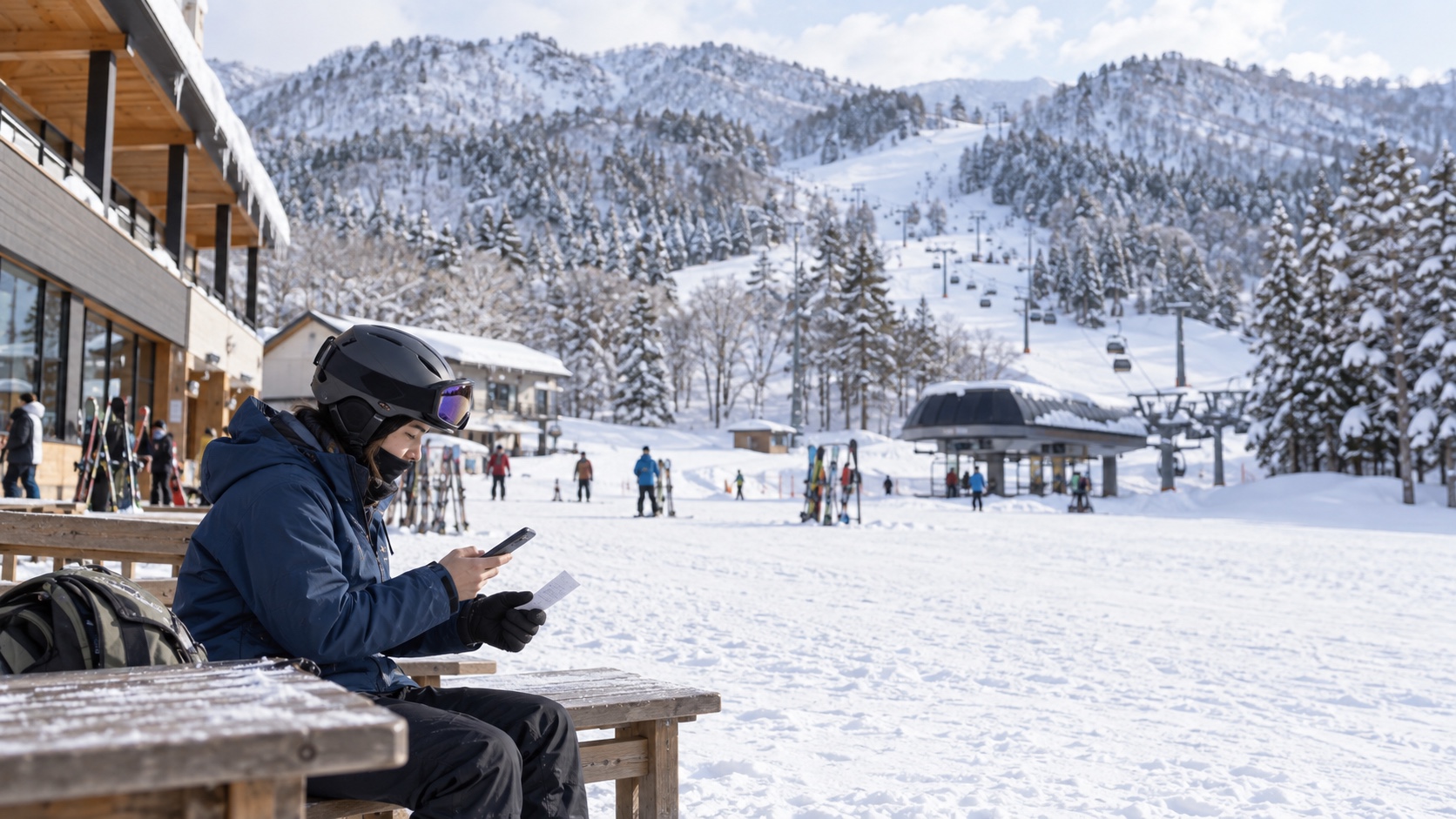
An emergency card should help another person act if you cannot explain everything yourself. For skiing or snowboarding in Japan, carry a short paper card and keep the same information on your phone.
The card should identify you, show important medical information, give emergency contacts, and point to your insurance and accommodation. You should also save the emergency contact for the exact ski resort you are visiting.
POINT
- Save 119 for ambulance or fire and 110 for police.
- Save the ski patrol or emergency number for the exact resort.
- Record your name, date of birth, preferred language, and emergency contacts.
- List important medical conditions, allergies, medicines, and doses.
- Carry your insurer's assistance number and your accommodation details.
Warning
Call 119 when an ambulance or fire response is needed. Tell the operator it is a medical emergency, give the clearest location available, describe what happened, and give a name and reachable phone number. On a managed ski slope, also alert resort staff or ski patrol as soon as possible when it is safe to do so. Resort procedures differ, so there is no single nationwide rule that patrol must always be called before 119.
What to put on your ski emergency card
Keep the card short enough to scan quickly. Use clear English. Add Japanese translations only when they are accurate.
Your name and basic details
Include:
- full legal name
- date of birth
- nationality
- preferred language
These details help staff distinguish one person from another and communicate more clearly. Do not use a nickname as the only name.
Emergency contacts and accommodation
Include:
- one contact at home, with country code
- one travel partner, guide, or tour contact in Japan, if applicable
- accommodation name, address, and phone number
Make sure your partner also knows where your card is. If one phone is lost or damaged, the other person may still have the information. Agree on a meeting point too; the guide on what to do if you become separated from your group explains the next steps.
Medical conditions, allergies, and medicines
Record the medical information that could change urgent care:
- serious medical conditions
- medicine and food allergies
- regular medicines, using generic names when possible
- the dose of each regular medicine
- important medical devices, such as an insulin pump
The CDC Yellow Book advises international travelers with medical issues to carry a summary of active medical problems, medicines, and allergies. If your medical history is complex, ask your healthcare professional what should appear on a short emergency summary.
Insurance and payment information
Record:
- insurer name
- policy number
- emergency assistance number
- the name shown on the policy
- whether your policy offers cashless treatment or normally requires you to pay first
JNTO advises travelers to keep their insurer's emergency contact number on their person and to understand how medical costs will be paid. This card does not prove that skiing, off-piste riding, or backcountry activity is covered. Check the policy wording separately, or use the travel insurance guide for skiing in Japan as a starting point.
Resort and location information
Before you start skiing, add:
- exact resort name
- resort or ski patrol emergency number
- accommodation or base area
- the lift, run, gate, or meeting point you expect to use
- a nearby sign, building, or other clear landmark
- smartphone GPS coordinates or current-location details
- an offline trail-map screenshot
Resort procedures and contact numbers differ. Hakuba Valley, for example, tells guests to contact resort staff or ski patrol as soon as possible and says each resort has its own emergency number. Check the official website or ticket office for your resort that morning.
GPS coordinates can help responders understand your position, but they do not guarantee that rescuers can reach you quickly. Also describe the resort, lift, run, gate, nearby sign, or visible landmark.
Numbers and contacts to save in Japan
119: ambulance or fire
Japan's Fire and Disaster Management Agency guide says to call 119 when an ambulance is needed. The operator may ask whether the emergency is medical or fire-related, where you are, what happened, the patient's age, and the caller's name and phone number.
On a ski mountain, use the clearest location you can: resort, lift, run, gate, nearby sign, building, landmark, or smartphone location. Stay on the line and answer slowly.
110: police
Call 110 for an urgent police response. For a medical emergency, use 119. Backcountry rescue procedures can involve police or fire services, so follow current local guidance for the area and give an accurate GPS location when possible.
Japan Visitor Hotline
JNTO's Japan Visitor Hotline is 050-3816-2787 within Japan and +81-50-3816-2787 from overseas. JNTO lists the service as available 24 hours a day, 365 days a year, in English, Chinese, and Korean for accidents, illness, natural disasters, and general visitor assistance.
The hotline is a support service. It does not replace 119 or 110 when urgent responders are needed.
Keep a phone copy and a paper copy
A phone note is easy to update. A small paper card still works if the phone is flat, damaged, wet, or locked.
A practical setup is:
- Put the full note in your phone's emergency information or medical ID feature.
- Put a short paper card in a zipped jacket pocket.
- Share the note with your ski partner or group leader.
- Review it when your resort, accommodation, insurer, or medicine changes.
Limit the personal data on a visible paper card. Store full document images and other sensitive details behind your phone lock. The emergency card should contain information that helps responders, not every travel record you own.
Copy this emergency card template
- Name: ____________________
- Date of birth: ____________________
- Nationality: ____________________
- Preferred language: ____________________
- Emergency contact at home: ____________________
- Contact in Japan / ski partner: ____________________
- Accommodation name, address, and phone: ____________________
- Medical conditions: ____________________
- Allergies: ____________________
- Medicines and doses: ____________________
- Insurance company: ____________________
- Policy number: ____________________
- Insurance assistance number: ____________________
- Resort today: ____________________
- Resort / ski patrol emergency number: ____________________
- Planned meeting point: ____________________
FAQ
Should foreign visitors carry their passport while skiing in Japan?
Yes. Japan's Immigration Services Agency says foreign nationals in Japan must carry their passport or an applicable permit and show it when requested by an authorized official. For a short-term visitor, this normally means carrying the original passport; a paper or phone copy does not replace it. A mid- to long-term resident carrying a residence card is not required to carry the passport as well. Keep the original document secure in a closed, protected pocket. Do not write the full passport number on a visible emergency card.
Can I assume a 119 operator will speak English?
Do not assume immediate English support on every call. The Fire and Disaster Management Agency promotes three-way telephone interpretation and multilingual tools, but its national guidance does not promise the same language service at every 119 center. Speak slowly. Start with “medical emergency,” then give the location, what happened, age, name, and phone number. If a Japanese speaker is nearby, ask them to help.
Is a phone emergency note enough?
It is useful, but a paper backup is sensible for winter sports. Cold, impact, water, a flat battery, or a locked screen can make a phone harder to use. Keep the paper version short and update both copies together.
Does this card replace a backcountry rescue plan?
No. A personal information card does not replace avalanche training, rescue equipment, a route plan, local registration requirements, reliable communication, or current mountain information. If you leave controlled terrain, follow the rules and rescue guidance for that exact area.
Make the card before your first lift
Create the note before the trip, then add the resort and patrol number each ski day. The useful version is not the longest one. It is the version that is current, easy to find, and clear enough for another person to use under stress.
Related guide
-
-
What Happens After a Ski Accident in Japan?
If you are injured while skiing in Japan, learn when to contact ski patrol, when to call 119, and what happens next.
続きを見る