.png)
Why "Standard" Travel Insurance Won't Cut It in Japan
Most riders arrive in Japan with some form of travel insurance. Most assume they're covered.
Most are wrong.
Standard travel insurance policies — the kind bundled with credit cards or booked as an afterthought — typically exclude two things that matter most in Japan's mountains: backcountry and off-piste activities, and Search and Rescue (SAR) costs.
In Japan, a private helicopter rescue alone can run ¥1,000,000–¥2,000,000 for a single mission. Hospital treatment for foreign visitors is billed at private rates — typically two to three times the standard cost. And if you leave an unpaid medical bill of ¥10,000 or more, you risk being flagged at the border and denied re-entry to Japan.
If you're planning to ride anywhere outside the marked pistes — including through official backcountry gates — your policy needs to explicitly cover it. "Probably fine" is not a coverage strategy.
-
-
Free Rescue" Doesn't Exist in Japan: What Every Visiting Snowboarder Needs to Know
You crossed an ocean for Japan's powder. Don't let that adventure end with a debt that follows you home for years. Reports of tourists getting lost — and rescued — in Japan's mountains are making headlines every season. What most visitors don't realize is that rescue here is never free. Here's the reality, backed by numbers and law. It's Not About Your Nationality — It's About Who Saves You There's no rule that says "free for Japanese, paid for foreigners." Whether you get a bill comes down to one thing: who responded to your rescue. Public services (free): If police ...
続きを見る
What About Credit Card Travel Insurance?
Many riders assume their credit card's complimentary travel insurance has them covered. In most cases, it doesn't — at least not for backcountry skiing in Japan.
Activity exclusions. Most credit card policies define "skiing" as on-piste, groomed resort skiing. Backcountry, off-piste, and tree riding are routinely excluded by default.
Low SAR limits. Even cards that do cover skiing often cap Search and Rescue at levels far below what a Japanese mountain rescue actually costs. A $20,000–$50,000 SAR cap sounds reasonable until you see a real helicopter bill.
Activation requirements. Some cards only activate travel insurance if you purchased the trip using that card. If you booked flights with points or a different card, you may not be covered at all.
No direct billing. Japanese hospitals typically require payment upfront or through a policy with direct billing arrangements. Credit card insurance often requires you to pay out of pocket and claim reimbursement later — which is a serious problem when the bill runs into the millions of yen.
Check your credit card's policy document specifically for the words "off-piste," "backcountry," and "Search and Rescue." If those terms don't appear as covered activities, assume you are not covered.
What to Look for in a Japan Ski Insurance Policy
Before comparing providers, here are the four things that actually matter:
Backcountry & Off-Piste Coverage
Is it included as standard, or does it require an add-on? The key phrase to look for is explicit inclusion of "off-piste" or "backcountry skiing." Vague language like "adventure sports" may or may not include it depending on the insurer's internal definitions — when in doubt, contact the provider directly before purchasing.
Search and Rescue (SAR) Coverage
SAR is separate from medical coverage. It covers the cost of getting to the hospital — helicopter flight time, ground search teams, fuel, equipment. Many budget policies cap this at a level that won't cover a real Japanese mountain rescue. Given that a full private helicopter mission in Japan can exceed ¥2,000,000, this number is worth checking carefully.
Medical Coverage Limit
Once you reach the hospital, a second bill begins. Given Japan's private-rate billing system for foreign visitors — typically two to three times the standard rate — a minimum medical coverage of $500,000 USD or the yen equivalent is a reasonable baseline. For serious injuries requiring surgery and extended hospitalization, bills in the several-million-yen range are not unusual.
The Gross Negligence Clause
Every policy has one. This clause allows insurers to void a claim if the accident was caused by intentional acts, gross negligence, or violation of local laws. In Japan, this has specific implications:
- Ducking a rope or barrier = potential gross negligence finding
- Entering a prohibited area = potential void of claim
- Riding a Tree Riding Zone without a required bib = resort rule violation
Staying within the legal framework isn't just about safety. It's what keeps coverage valid.
-
-
Japan's Ski Resort Rules: The Vital Difference Between "Off-Piste" and "Prohibited Areas"
Japan’s world-class powder, famously known as "Japow," is a dream for every rider. Many visitors head straight for the trees and sidecountry to find those deep, untouched stashes. However, there is a common and potentially fatal misunderstanding: "In Japan, you can ride anywhere." This is not true. In major areas like Hakuba and Niseko, strict local rules exist to separate managed safety from the raw wilderness. Crossing a single rope without understanding these rules doesn't just put your life at risk—it could also instantly void your insurance. As a former ski resort employee (20 years ago) and a current resident ...
続きを見る
Comparing Insurance Options for Skiing in Japan
The four providers below are among the most commonly used by foreign visitors riding backcountry and off-piste in Japan. Each has different strengths depending on nationality, budget, and riding style.
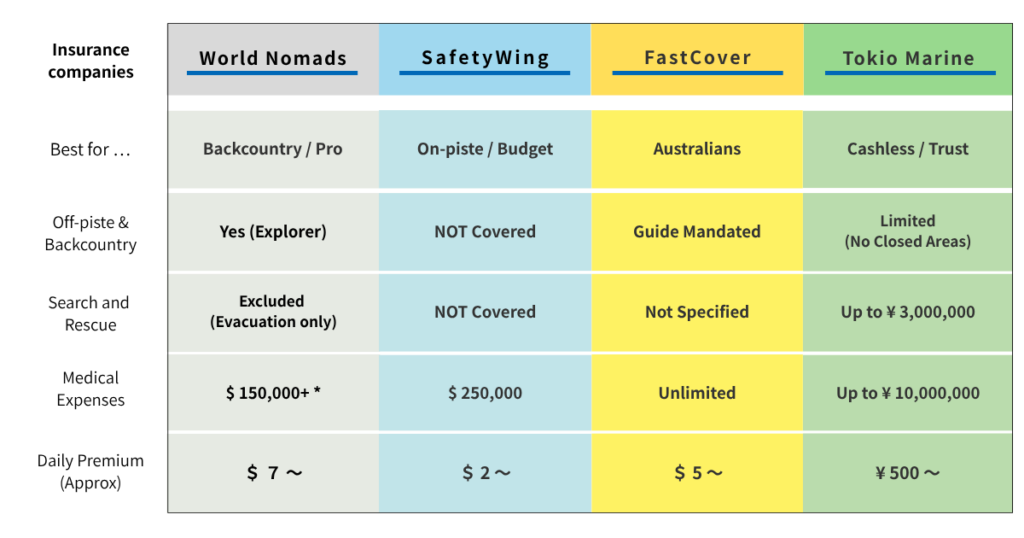
※Caption: Key coverage details compared across four providers. Prices are approximate and subject to change — always verify current rates and policy terms directly with the provider.
World Nomads
World Nomads is built around adventure travel. Backcountry skiing is covered as standard under their Explorer plan, without requiring a separate add-on. The $500,000 SAR limit is the highest of the international options covered here, and the claims process is well-documented for English-speaking travelers.
Worth considering if:
Riding backcountry gates is part of the plan, or if a high SAR ceiling is a priority. The Explorer plan's explicit inclusion of off-piste activities removes much of the ambiguity found in other policies.
Worth noting:
Pricing varies significantly by nationality. The $7/day figure is an approximation — actual premiums depend on age, origin country, and trip length. The gross negligence clause applies regardless of plan tier.
SafetyWing
SafetyWing offers two main plans: Nomad Insurance Essential and Nomad Insurance Complete. Both are designed primarily for travel medical and health coverage rather than dedicated backcountry ski insurance.
Skiing and snowboarding may be covered when riding on marked pistes and following local safety rules. However, off-piste skiing and snowboarding outside marked territory are excluded, even with the Adventure Sports add-on.
Worth considering if:
You plan to ride mainly on marked resort runs and want flexible travel medical coverage that can be purchased while already abroad. SafetyWing may also suit long-term travelers who prefer a subscription-style policy.
Worth noting:
SafetyWing is not designed for riders planning to enter backcountry terrain or ride outside marked pistes. Emergency evacuation coverage is subject to specific limits and may not cover all mountain Search and Rescue costs.Always review the official policy wording before purchasing.
FastCover
FastCover is an Australian-market product with a strong presence in Japan ski travel.
Backcountry coverage requires an add-on, but higher-tier plans offer unlimited SAR coverage — one of the more competitive options available for Australian passport holders.
Worth considering if:
You hold an Australian passport and are comfortable with the FastCover claims process. The unlimited SAR option on higher-tier plans is a meaningful differentiator.
Worth noting:
FastCover is primarily available to Australian residents. Eligibility should be confirmed before spending time on a quote.
"Unlimited" SAR is plan-dependent — verify which tier includes it.
Tokio Marin
Tokio Marine is a Japanese insurer. Claims are processed domestically, coordination with Japanese hospitals is more direct, and the ¥3,000,000 SAR ceiling is well-matched to Japan's actual rescue cost structure.
Worth considering if:
Visiting Japan frequently, or if having a policy that operates entirely within the Japanese system is a priority. The domestic claims process can reduce friction significantly in a real emergency.
Worth noting:
The application process is primarily in Japanese. English support exists for some products but may be limited.Allow extra time if navigating a Japanese-language interface is unfamiliar.
Frequently Asked Questions
Does travel insurance cover backcountry skiing in Japan by default?
Not usually. Most standard travel insurance policies exclude backcountry and off-piste activities unless explicitly stated otherwise. The policy wording should specifically mention "off-piste" or "backcountry skiing" as covered activities. If it isn't mentioned, assume it's excluded and contact the provider for clarification.
What happens if I get rescued without insurance in Japan?
A bill will follow — potentially in the millions of yen. Private rescue organizations and hospitals are entitled to charge for their services, and foreign visitors are billed at private rates. Leaving Japan without settling the debt can result in being flagged at the border and denied re-entry under Japan's Immigration Control Act.
Is rescue free if the police or fire department responds?
Public services — police and fire department helicopters and ground teams — do not charge for their response. However, public teams are frequently unable to respond in bad weather, at night, or when multiple incidents occur simultaneously. In areas like Hakuba, private teams are deployed regularly to prioritize response speed. The risk of a paid rescue is higher than most visitors expect.
Will insurance cover a claim if I ducked a rope?
Almost certainly not. Ducking a rope — crossing a barrier where there is no official gate — violates resort safety rules and may carry legal implications under Japan's Minor Offense Act. Insurers can classify this as gross negligence and void the claim. Coverage holds when riders stay within legal boundaries.
Is insurance necessary even for on-piste riding?
Yes. On-piste accidents can still result in significant medical bills for foreign visitors in Japan. Private billing rates, combined with potential hospitalization costs, make adequate medical coverage relevant regardless of where you ride.
Is it possible to buy insurance after arriving in Japan?
Some providers allow this — SafetyWing, for example, uses a subscription model that can be started at any time. However, most insurers have a waiting period before coverage activates, and pre-existing incidents may be excluded. Purchasing before arrival removes these complications.
Quick Checklist Before You Ride
CheckList
✅ Does the policy explicitly cover backcountry and off-piste skiing?
✅ Is Search and Rescue listed as a covered benefit?
✅ What is the SAR coverage limit? (¥2,000,000+ or equivalent is a reasonable minimum)
✅ What is the medical coverage limit? ($500,000 USD minimum is a reasonable baseline)
✅ Have you read the exclusions, particularly the gross negligence clause?
✅ Does the policy cover Japan for your specific travel dates?
✅ If relying on credit card insurance — have you confirmed backcountry activities are explicitly included?
The Bottom Line
Japan's mountains are worth the trip. Making sure the coverage is in order before you ride is the unglamorous part of that preparation — but it's also the part that determines whether a bad day on the mountain stays a bad day, or becomes something much harder to recover from.
The comparison above is a starting point. Policy terms change, premiums vary by nationality, and the details matter. Verify current rates and wording directly with each provider before making a decision.
Compare Current Insurance Options
Coverage varies by country, plan, activity, and policy wording. Check off-piste skiing, Search and Rescue, and medical coverage before purchasing.
※ Affiliate disclosure: HakubaSafety may earn a commission through these links. Always review the official policy wording before purchase.